
Two suit lengths sit side by side on my counter. They look almost the same. One costs three times the other. As a fabric merchant — and a Chartered Accountant — here is exactly where that money goes.
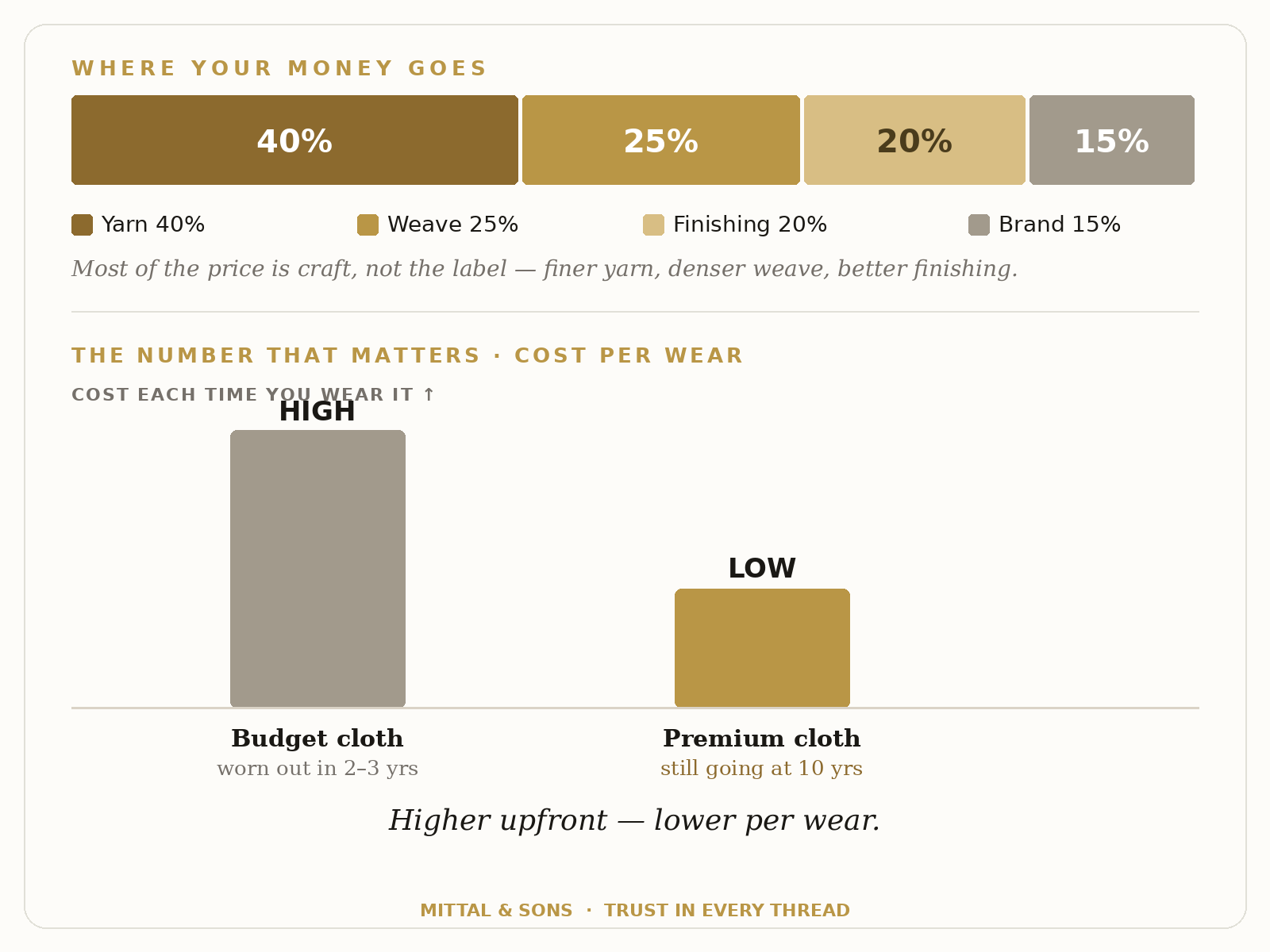
The four things you are paying for
- Yarn quality — about 40%. Finer, longer wool fibres are rarer and harder to spin. This is what the Super number measures, and it is the single biggest driver.
- Weave density — about 25%. More threads per inch means more yarn and more loom time, and cloth that holds its shape far longer.
- Finishing — about 20%. The mill’s invisible work: softness, durability, wrinkle-resistance. Cheap cloth skips it; premium cloth is defined by it.
- Brand — about 15%. Consistency and genuineness, so every metre behaves the same. Worth paying for — as long as you pay knowingly.
What “Super 120s” really tells you
The Super number measures one thing — how fine the wool fibre is (Super 120s is roughly 17.5 micron). A higher number simply means a finer, softer fibre. It says nothing about how much wool is in the cloth.
By the international wool standard, “Super” is meant only for pure or wool-rich cloth. Yet you will find “Super 120s” printed on the selvedge of fabric that is barely 20% wool. It looks the part — it just will not feel like it. The honest tell: never read the Super number alone. Ask for the wool percentage. More on this in Super 100s, 120s, 140s: what the wool count really means.
The number that matters: cost per wear
As an accountant, this is the figure I would put in front of you. A good Super 120s suit lasts a decade; cheap polyester tires in two or three years. Spread the price across every wear — as the chart above shows — and the “expensive” cloth is often the cheaper one. Higher upfront, lower per wear.
So is the premium worth it?
Pay up for your wedding and the big milestones, for a suit you will own and wear for ten years, and for cloth you will genuinely feel and enjoy every time. Skip the premium for daily office wear (a Super 110s–120s looks just as sharp), for something you will wear only once or twice, and for chasing a higher number for ego rather than use.
Judge any cloth in 30 seconds
- Crush it. Quality springs back; poor cloth stays creased.
- Hold it to the light. A tight, even weave means quality; gaps mean cheap.
- Feel the weight. Good cloth feels substantial, never papery or plasticky.
- Read the number, then ask the wool %. Match the Super count to how you will use it, not to ego.
That is the whole game: buy the right cloth for how often you will wear it, and always ask what is really in it. If you are ever unsure, bring the cloth to us — or message us on WhatsApp — and we will tell you straight.